


How to expand your vocabulary
07/03/2020
The order of adjectives in English
19/01/2021
We must remember that there are two types of listening: active listening (i.e. aimed at understanding everything we are listening to by making a constant and indeed ‘active’ effort) and passive listening (i.e. listening to podcasts in the background while doing another activity, without concentrating on understanding everything that is being said, but with the aim of training your ear to the sounds of the foreign language).
Both types of listening are important and recommended. However, in this blog post I will refer only to active listening and I will explain step by step a method to effectively practise active listening. I will give you some advice that has proved to be very useful for my students and has helped them to considerably improve their listening comprehension skills.
Why is listening comprehension more difficult than written comprehension?
W e should consider that most of the difficulties in understanding an oral passage compared to a written text mainly arise from these three factors (in addition to psychological factors related to anxiety):
So how can I improve my listening skills?

In this blog post I will give you practical step-by-step instructions to do an effective listening comprehension exercise.
1 - Select the topic and choose the podcast or audio file to work on (without looking at the transcript and, of course, without keeping it before your eyes during the listening exercise!)
2 - Before clicking on the ‘play’ button and listening to the audio file, you must prepare yourself. I suggest doing a short brainstorming session (max. 15 minutes). Think of words or phrases that might be used in the test you are about to listen to, use a dictionary to look up the translation of some words or phrases that might come to your mind only in your mother tongue and not in the target language and which might be useful to talk about the chosen topic.
In this way you will create a small glossary that will also be very useful to expand your vocabulary. In the post on expanding vocabulary we talked about the importance of learning words and phrases by memorising them in their context to remember them more easily. The preparation will certainly help you to approach the listening exercise in a more relaxed way and you will surely definitely have learnt some new terms or expressions which may not have been used in the text you listened to, but which may be useful in the future.

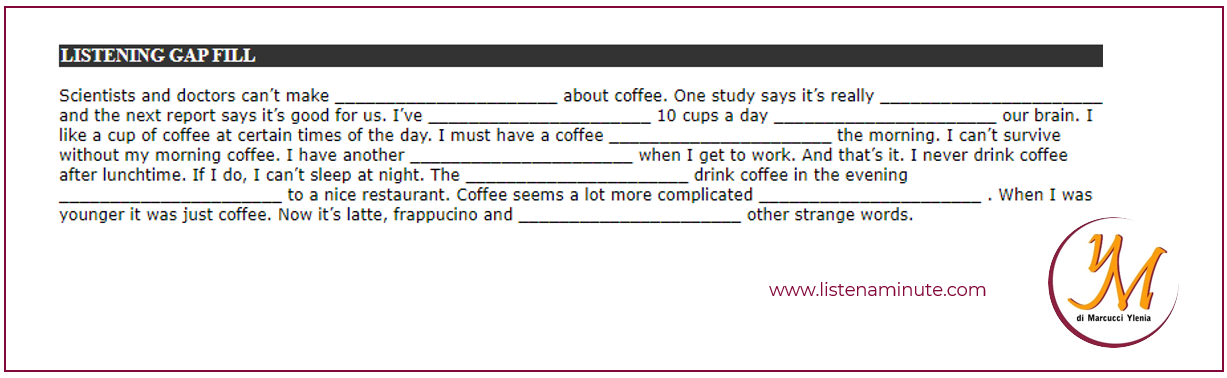
Example of a ‘gap-fill’ exercise
7 - As an alternative to the transcript you can make (point 5) or to additional exercises to check your understanding of the text (point 6), you can consult the transcript of the text which is generally provided in all textbooks or on the different websites containing podcasts. Read the transcript, note down the words which you were stuck on and you will see that, in most cases, these text passages are not so difficult. As mentioned at the beginning of this blog post, often the difficulty we encounter in listening comprehension lies in the fact that words are connected together when the speaker talks fast and we do not recognise each individual word in their speech. If there are unfamiliar expressions or words, use a dictionary to understand the meaning of an unclear sentence. Transcription should always be your last resort: doing a listening exercise and reading the written text because you can't understand the passage is a bit like throwing in the towel and giving up. However, it is true that if a passage is difficult, you must be able to somehow complete the exercise and move on.

Example of podcast with transcript
8 - Good! Now you have understood the text well enough. Some details may still be unclear and, perhaps out of curiosity or to remove a doubt, you may want to look quickly at the transcript of the text (focusing only on the parts where you encountered difficulties). Now listen to the full audio file one last time, from beginning to end, without the transcript and without looking at your notes: everything should be understandable and clear!
9 - This is the most important step! Download the audio file and create an archive on a USB stick or a folder on your computer in which you will collect all the audio files you have listened to and for which you have completed the listening exercise following these recommended guidelines. Then listen to these audio files regularly (at least twice a month). Each time you listen they will seem more comprehensible and you will also consolidate your knowledge of the vocabulary they contain, which you may have looked up in the dictionary and included in your vocabulary notebook.